
What are volcanoes???🤷♀️
HELLO TO ALL.THESE MOUTAINS TO NICE AND INTERESTING,BUT DANGEROUS.
A volcano is a rupture in the crust of a planetary-mass object, such as Earth, that allows hot lava, volcanic ash, and gases to escape from a magma chamber below the surface. Earth’s volcanoes occur because its crust is broken into 17 major, rigid tectonic plates that float on a hotter, softer layer in its mantle. A volcano is a rupture in the crust of a planetary-mass object, such as Earth, that allows hot lava, volcanic ash, and gases to escape from a magma chamber below the surface. Earth’s volcanoes occur because its crust is broken into 17 major, rigid tectonic plates that float on a hotter, softer layer in its mantle.
Volcanoes can either be active dormant or extinct.😁
An erupting volcano is an active volcano that is having an eruption… A dormant volcano is an active volcano that is not erupting, but supposed to erupt again. An extinct volcano has not had an eruption for at least 10,000 years and is not expected to erupt again in a comparable time scale of the future .
4 major varieties of volanoes.👌
Cinder cone- are the simplest type of volcano. They are built from particles and blobs of congealed lava ejected from a single vent. As the gas-charged lava is blown violently into the air, it breaks into small fragments that solidify and fall as cinders around the vent to form a circular or oval cone.
Composite- Some of the Earth’s grandest mountains are composite volcanoes–sometimes called stratovolcanoes. They are typically steep-sided, symmetrical cones of large dimension built of alternating layers of lava flows, volcanic ash, cinders, blocks, and bombs and may rise as much as 8,000 feet above their bases.
Shield- is a large volcano with shallowly-sloping sides. … Consequently, a volcanic mountain having a broad profile is built up over time by flow after flow of relatively fluid basaltic lava issuing from vents or fissures on the surface of thevolcano. Many of the largest volcanoes on Earth are shield volcanoes.VLg
Lava domes-
a lava dome or plug dome is a round-shaped mound created by the eruption of viscous lava by a volcano. Lava domes are formed when erupting lava is too thick to flow and makes a steep-sided mound as the lava piles up near the volcanic vent.
10. Pacaya, Guatemala

Pacaya first erupted roughly 23,000 years ago, and was fairly active until around 1865. Then she blew her lid 100 years ago and has been consistently flaring ever since; to that end, there are now several lava rivers flowing through the surrounding hills.
9. Mt. Stromboli, Italy

Named after the delicious Italian turnover (but loaded with super-hot lava instead of super-hot meats and cheeses), this volcano has been erupting almost continuously for 2,000 years. Around 100 years ago, the island was inhabited by a few thousand peeps, but most of them moved away due to the incessant ash showers and threat of imminent death.
8. Sakurajima, Japan

This volcano used to be an island, until one day it said “Yeah, right!” and proceeded to spurt out so much lava that it connected itself with the Osumi Peninsula. After assimilating to the “mainland” culture, Sakurajima’s been erupting with joy (and lava) ever since.
7. Kilauea, Hawaii

Anywhere between 300,000 and 600,000 years old, Kilauea is extraordinarily active for its age. It’s the most active volcano out of the five that exist on the island of Hawaii, and it’ll still beat you in racquetball. The area surrounding it is rife with tourism and features the original Volcano House: a hotel built in 1866 that Mark Twain once stayed in, and that guy was hilarious!
6. Mt. Cleveland, Alaska

Thankfully having nothing to do with Ohio and everything to do with America’s 22nd AND 24th president, Mt. Cleveland is one of the most active volcanoes in the Aleutian Islands. It’s situated on the completely uninhabited Chuginadak Island (which is hilarious to say 3x fast), and is the source of heat for a handful of hot springs in the surrounding area.
5. Mt. Erebus, Antarctica

As the southernmost active volcano on earth, Erebus reigns as champ of the most underwhelming volcano stat ever. On a more interesting note, an explorer named James Clark Ross discovered the volcano in 1841, along with a second volcano sitting right next to it. Ross had a tough decision — he wanted to name each of the volcanoes after his ships, the Erebus and the Terror. Needless to say, Ross named the wussy inactive volcano Mt. Terror and the actual-terror volcano Mt. Erebus. Erebus has never forgiven Ross, and has been rumbling ever since.
4. Volcán de Colima, Mexico

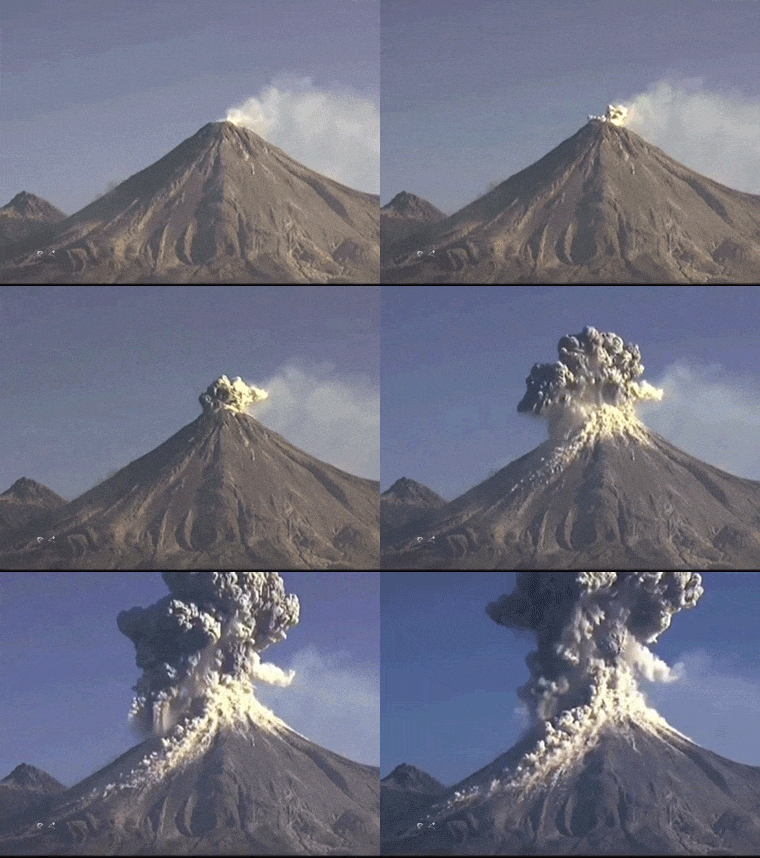
This lil’ guy here has erupted more than 40 times since 1576, making him one of the most active volcanoes in North America. Colima is also known to produce some pretty intense lava bombs that can travel upwards of two miles. Yeah, lava bombs — let’s get back to that; it’s when a volcano forms molten rock larger than ~3in in diameter and then hurls it into the sky with no regard or intended target. Volcanoes be reckless.
3. Mt. Yasur, Vanuatu

Much like Joan Rivers, Yasur’s been erupting extensively for about 800 years now, but that hasn’t stopped it from being a sought-after tourist destination. The eruptions can occur several times an hour; to make sure visitors are safe, the local government’s created a 0-4 level system, with zero allowing access, and 4 meaning why the hell are you on Tanna Island?!
2. Mt. Merapi, Indonesia

A volcano finally worthy of its name, Merapi literally translates into “fire mountain,” which is fitting when you realize the blowhard releases smoke 300 days out of the year. It’s also the youngest in a group of volcanoes situated in Southern Java, so it’s easy to understand where all its angst comes from, and even though it thinks the older Indonesian volcanoes don’t understand it, they were once just like it. Anthropomorphic volcanoes aside, Merapi is a seriously dangerous volcano, as evidenced in ’94 when 27 people were killed by pyroclastic flow, and Snoop Dogg still wasn’t loving people.
1. Erta Ale, Ethiopia

The most active volcano in Ethiopia, and one of the rarest in the world (it has not one, but two lava lakes), Erta Ale suspiciously translates to “smoking mountain” and has a reputation as one of the harshest environments in the entire world. The last major eruption was in 2008, but the lava lakes are in constant flow year-round.
 brainiacks
thank you for like my post
LikeLike
Thanks for liking my English#2
LikeLike
anytime I liked it that’s y I liked it
LikeLike
nice work atuns
LikeLike